
10 deadliest natural disasters in the Philippines
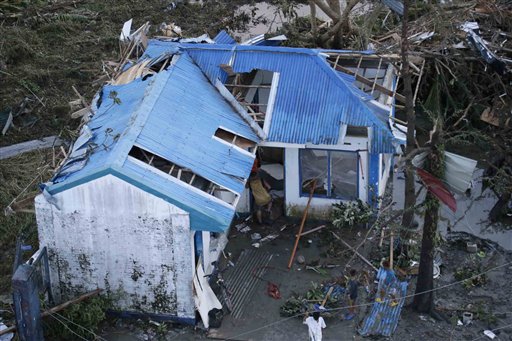
MANILA, Philippines- Super typhoon “Yolanda” (Haiyan) may go down in history as the deadliest natural disaster to hit the calamity-prone Philippines, with authorities estimating at least 10,000 dead on one island alone.
Haiyan made landfall in the eastern island of Samar on Friday and then cut through the central islands, causing storm surges, strong winds and heavy rain that flattened buildings, toppled trees and electrical poles and washed away houses and cars.
The provincial police chief in Leyte, one of the hardest-hit islands, estimated that 10,000 had died there. In Samar, a disaster management official said 300 had died in one town alone with 2,000 still missing.
The death toll from Haiyan is still rising as many areas remain isolated after the storm knocked out power and communications and left many roads and bridges impassable.
Such disasters are all too frequent in the Philippines, which is located along a typhoon belt and the so-called Ring of Fire, a vast Pacific Ocean region where many of Earth’s earthquakes and volcanic eruptions occur.

1. A tsunami triggered by a magnitude 7.9 earthquake devastates the Moro Gulf on the southern island of Mindanao on August 16, 1976, killing between 5,000 and 8,000 people.
2. Tropical Storm Thelma unleashes flash floods on the central city of Ormoc on Leyte island on November 15, 1991, killing more than 5,100.
3. Typhoon Bopha smashes into the main southern island of Mindanao on December 3, 2012. Rarely hit by cyclones, the region suffers about 1,900 people dead or missing.
4. A 7.8 magnitude earthquake strikes the mountain resort of Baguio city and other areas of the northern Philippines on July 16, 1990, killing 1,621 people.
5. Typhoon Ike hits the central islands on August 31, 1984, killing 1,363 people.
6. Taal volcano, about 60 kilometres (30 miles) from Manila, erupts on January 30, 1911, killing about 1,300 people living in nearby villages.
7. Mayon volcano in the far east of the country erupts on February 1, 1814, burying the nearby town of Cagsawa with ash and rock and killing about 1,200 people.
8. An entire mountainside collapses on the village of Guinsaugon on the central island of Leyte on February 17, 2006, killing 1,126.
9. Typhoon Washi hits the northen part of Mindanao island on December 16, 2011, killing at least 1,080 people.
10. Floods and landslides unleashed by Typhoon Trix kill 995 people in the Bicol region of the main island of Luzon on October 16, 1952.
SOCIAL MEDIA PLAYS A BIG ROLE IN DISCERNING INFORMATION DURING CALAMITIES
The term “social media” refers to Internet-based applications that enable people to communicate and share resources and information.
The use of social media for emergencies and disasters on an organizational level may be conceived of as two broad categories. First, social media can be used somewhat passively to disseminate information and receive user feedback via incoming messages, wall posts, and polls. A second approach involves the systematic use of social media as an emergency management tool. Systematic usage might include: 1) using the medium to conduct emergency communications and issue warnings; 2) using social media to receive victim requests for assistance; 3) monitoring user activities and postings to establish situational awareness; and 4) using uploaded images to create damage estimates, among others.

Are you familiar with Twitter, Tumblr, and Facebook? I know most of you have one. Social media is very important in collaboration and in communicating other people around the globe. It helped families, social workers, and government in discerning info during calamities.
Through social media every family can easily communicate their relatives from other places especially those outside the country. While in social workers it can be a tool to educate them info’s during calamities. Our government most especially can spread or disseminate information through the use of social media.

It is very obvious that social media is a big help. Do you remember the super typhoon Yolanda that hit the Tacloban, Samar, and Leyte? By using social media are able to informed other countries that we are suffering hunger, and destruction of facilities brought by Yolanda . In connection with, the countries who are members of ASEAN, APEC, and European Union helped us in terms of financial survival. While the families of Filipinos who are living abroad used social media to communicate their love one’s , if they are okay. Social media is a gift of modern time that is a big help if it is properly use.
“Dealing with Disaster”
Social media played a huge role in disaster response during the recent calamities in the Philippines. Let’s take a look at how social media was effectively used:
1. CONNECTING WITH LOVED ONES:
Within 24 hours after a disaster happened, people start tagging and posting the names and pictures of missing loved ones. It was an online sounding board to keep everyone updated whether their families, relatives, or friends had survived or not.
2. NOTIFYING THE AUTHORITIES:
Since the recent disasters affected huge areas and there were only a few people with minimal technical assistance during the first few days, social media filled in the information gaps.
3. ORGANIZING RELIEF EFFORTS:
The best way to get information about needed assistance like C130 flights, medical help, and where to give and receive relief goods was through social media.
4. INCREASING PUBLIC AWARENESS:
Everyone helped in keeping tabs. Reports, such as repacking the relief goods from Indonesia with a government bag or with the politicians’ seal on it, were plastered all over the internet.
5. EMPOWERING AND STRESS DEBRIEFING FOR SURVIVORS:
The affected individuals were empowered because they feel that in their own way, they were able to take control of the situation they were in.
Differences Between Old and New Media
|
Social Media Two-way conversation Open system Transparent One-on-one marketing About you Brand and User-generated Content Authentic content
Metric: Engagement Actors: Users/ Influencers Community decision-making Unstructured communication Real time creation Bottom-up strategy Informal language Active involvement Deep Analytics Paid, Owned, Earned |
Traditional Media One-way conversation Closed system Opaque Mass marketing About ME Professional content Polished content
Metric: Reach/ frequency Actors/ Celebrities Economic decision-making Controlled communication Pre-produced/ scheduled Top-down strategy Formal language Passive involvement Poor analytics Paid |





 Baloro